What Foundational Principle Helps Businesses Avoid the Constant Change Trap When Applying Generative AI to Core Operations?
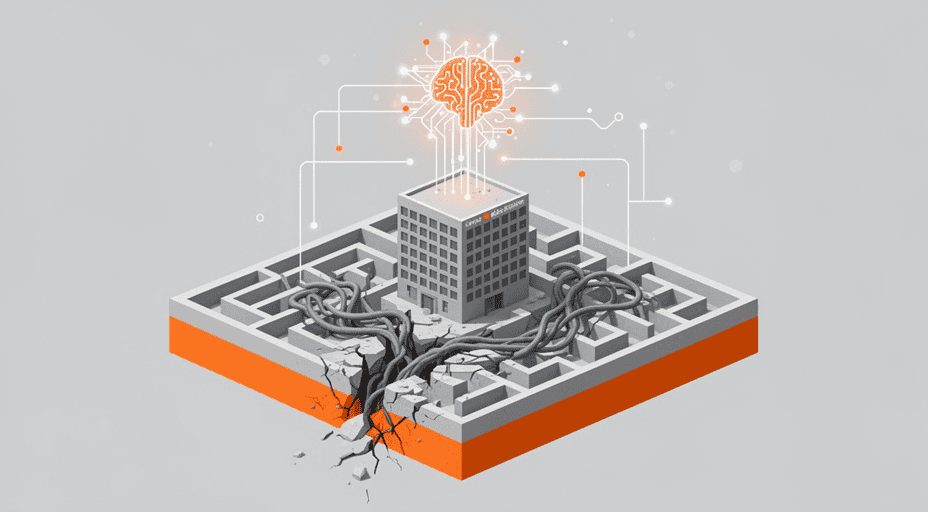
A mid-sized logistics company promised itself: “We must integrate AI into our order processing workflow by 2025.” They adopted a large language model (LLM) to analyze customer emails, extract shipping details, and automatically generate transport orders. After three months, they had developed four different prompt versions, switched model providers twice, and nearly shipped a high-value container to the wrong address because the LLM “hallucinated” the destination. The operations team lost trust. Leadership began questioning: why does the more we adopt generative AI, the more fragile our processes become?
This is precisely the trap that most businesses fall into when introducing Generative AI into core operations: constant change. Not the kind of controlled change aimed at adaptation, but a chaotic cycle of patching—rewriting prompts weekly, chasing the latest model version, and then panicking whenever benchmark metrics fluctuate. This article dissects the underlying architectural thinking that leads to this trap and establishes a foundational principle for escaping—not by avoiding AI, but by placing it correctly within the system.
When a Probabilistic Model Is Mistaken for a Business Operating System
To understand the root cause, we must strip large language models down to their most basic form: a system that calculates the probability distribution of the next token, based on vast training data and current context. It generates text that looks coherent, but it lacks any mechanism for verifying business accuracy, has no persistent state memory, and cannot guarantee that the same input will produce the same output tomorrow. It is a probabilistic tool, designed for flexibility and creativity—not for absolute consistency.
In contrast, core operational workflows (order-to-cash, inventory management, credit approval, etc.) have a completely different nature. They are sequences of actions that must be executed deterministically and auditable. When an order arrives, the customer code must be correctly mapped to the pricing table; when inventory drops below a safety threshold, an alert must be triggered according to predefined rules. These constraints do not come from probabilities—they stem from business logic and tightly bound relational data structures.
Most mistakes originate from blurring these two layers. Businesses treat the LLM as an “operational brain,” handing it the entire pipeline: reading emails, understanding intent, deciding next steps, and even writing directly into the database. Every model update or prompt refinement changes the entire pipeline behavior. To mitigate risks, they add validation layers, “guardrails,” and more refinements—an endless loop. In reality, they are attempting to build a house on continuously shifting ground.
Key Takeaway: Generative AI is an interface layer, not the engine of operations. Confusing these roles is the root of all instability.
The Three Pillars of Invariance in Core Operations
To maintain a stable system amid technology waves that change every quarter, businesses must clearly identify which components must not change just because AI does. Three pillars form this invariance.
1. Relational Data Model
Every core operational process boils down to a set of entities and their relationships: Customer, Order, Product, Warehouse, Invoice. This structure is independent of how data enters—manual input, API, or natural language chat. When a business begins letting the LLM “freely decide” which data fields are necessary or bypasses schema for the sake of flexible extraction, they compromise the integrity of the entire system. A normalized database schema must be preserved as the single source of truth.
2. Business Rules Engine Layer
Rules such as “if order value exceeds X million VND, require managerial approval” or “if a customer’s overdue payment exceeds Y days, block warehouse shipment” serve as the business’s firewall. These must be defined with explicit logic, be testable, and completely decoupled from the AI’s language comprehension layer. A traditional rule engine (e.g., decision table, DRL, or even pure code with full unit tests) remains the correct choice for this layer.
3. Stateful and Idempotent Processing Pipeline
Core operations require that every action occurs only once and is traceable. This directly contradicts the stateless nature of an LLM call. Therefore, the pipeline must be designed with clear state tracking, logging every decision, and critically, must support safe retries without side effects (idempotency). The LLM’s role is confined to transforming unstructured input into structured data; everything that follows is handled by traditional workflow engines.
These three pillars are not enemies of AI. On the contrary, they are the very foundation that enables AI to deliver value without risk. When the data model is solid, the AI doesn’t need to infer rules; when the rule engine is transparent, AI output can be instantly verified; when the pipeline is idempotent, retrying with a different prompt won’t corrupt real-world data.
The Deterministic Core – Generative Shell Architecture
From the separation of these three pillars, an explicit implementation architecture emerges: Deterministic Core, Generative Shell. This is not a theoretical model but a technical principle that can be directly mapped to code and infrastructure.
In this architecture:
- The Deterministic Core includes a relational database, message queue (Kafka/RabbitMQ), rule engine, and workflow orchestrator (Temporal, Camunda, or a custom state machine). All decisions that alter system state originate from this core only.
- The Generative Shell consists of LLM gateway APIs, prompts managed as code (Prompt-as-Code), and output converters. The shell receives natural inputs (email, chat, scanned text) and returns a fixed, well-defined data structure (e.g., a fixed JSON Schema) that the core can consume.
A typical request processing flow would be:
1. A customer email arrives; the Shell invokes the LLM to extract it into an OrderIntent object with fields like customerCode, listOfSKU, and requestedDeliveryDate.
2. This JSON is schema-validated. If required fields are missing, the Shell returns a clarification question to the customer (potentially generated by LLM, but based on schema requirements).
3. Once the JSON is valid, it’s pushed to the core’s message queue. The workflow engine picks up the OrderIntent, maps customerCode to pricing via the database, applies the rule engine to check credit limits, and generates a real SalesOrder.
4. If the LLM provider is switched next week, the core remains unchanged. If the prompt needs refinement to improve extraction accuracy, only the Shell is affected and can be independently tested.
The critical point here is that no LLM API call is allowed to write directly into primary data tables. All data from the Shell must pass through a mapping and business rule validation layer. This creates a data contract between two worlds: the flexible, fast-changing world of AI and the rigid, reliability-demanding world of operations.
A Real Simulation: The E-Commerce Marketplace
Let’s examine how a hypothetical company—an e-commerce platform for industrial components called PartHub—applied this architecture after a costly failure.
Initially, PartHub used an LLM to process quotation requests from technical PDF files. Engineers wrote a long prompt instructing the model to read engineering drawings, identify part codes, quantities, and even recommend prices based on transaction history. Their old pipeline was: input PDF → LLM → direct update to CRM and warehouse.

Disaster struck when a PDF with ambiguous technical symbols caused the model to confuse two types of load-bearing screws. The system quoted a price 30% below cost. The order was auto-created, goods shipped, and the error was only detected during financial reconciliation.
After the incident, the team redesigned everything around the Deterministic Core – Generative Shell principle:
- They built a standardized DB schema for
QuotationRequest,QuotationLine, with full foreign key constraints. - A hard-coded rule engine ensured sales prices could never fall below cost × 1.15; special prices required approval from authorized personnel.
- The LLM Shell was now assigned a single task: read the PDF and return a JSON like
{ "partNumber": string, "quantity": number, "description": string }. It was explicitly forbidden from generating pricing. - Before the JSON entered the core, a validator checked whether the
partNumberexisted in the master catalog. If not, the request went into a “manual verification” queue, and the Shell would generate a response to the customer: “We’re verifying component code XYZ and will respond within 2 hours.” - Price calculation, order creation, and inventory deduction became responsibilities of the deterministic workflow engine, fully auditable.
After implementation: automated quote generation rose from 40% to 75% of all requests. More importantly, business errors related to incorrect pricing or wrong parts dropped to zero. Every time OpenAI launched a new model, the team spent only half a day evaluating extraction quality on a test set—the model switch caused no disruption to any operational process.
A Staged Implementation Strategy
Not every company can redesign their entire system immediately. Below is a practical roadmap to adopt this principle without organizational shock.
Phase 1: Define Boundaries (2–4 weeks)
Use markers and a whiteboard to map out all core workflows. Highlight in red any points where the LLM currently writes directly to data—these are the highest-risk areas. Then define “data contracts” for each: what input is expected, and what fixed output (JSON schema) should be returned. No code changes yet—just a clear design document.
Phase 2: Isolate the Shell Layer (4–8 weeks)
Create a dedicated service (microservice or at least an isolated module) responsible for all LLM calls. This service takes raw inputs (text, files) and returns only schema-validated results. Legacy code remains intact, but instead of scattered LLM calls, other modules go through this service. The separation allows independent testing of prompts and models. Build a test dataset: a few hundred real input samples with known expected outputs. This becomes the lifeline when changing models.
Phase 3: Add Pre-Write Validation Layer (2–4 weeks)
For every JSON output from the Shell, insert a middleware that checks core business rules before inserting into the database. Rules that can’t be automated yet are routed to manual review queues. This phase is critical for building trust with operations teams. When they see the system automatically reject dangerous decisions and issue clear warnings, resistance to AI drops significantly.
Phase 4: Harden the Core (ongoing)
Gradually migrate complex workflows to a deterministic workflow engine with clear state machines. Actions such as sending emails, creating employee tasks, and updating order status must reside in the deterministic core. Everything in the core must support rollback and be idempotent.
Key Takeaway: Speed is not the top priority. Data stability and control—not automation rate—are the true success metrics when integrating AI into core operations.
Comparative Framework of Approaches
To illustrate the differences, here’s a comparison of three common implementation patterns in 2025–2026.
| Criterion | Prompt-Only (Pure LLM) | Simple RAG (LLM + Retrieval) | Deterministic Core – Generative Shell |
|---|---|---|---|
| Location of Business Decision Logic | Inside prompt, not explicit | Distributed between prompt and retrieval results | Independent rule engine, deterministic |
| Regression Testing Capability | Very low, relies on subjective evaluation | Medium, retrieval logic can be tested | High, entire pipeline unit-testable |
| Impact of Model Change | Entire system behavior may change | Changes how information is synthesized | Only affects Shell; core remains unchanged |
| Audit Trail & Compliance | Difficult due to missing intermediate states | Partial, but final decision is still opaque | Full, every state change is logged |
| Long-term Maintenance Cost | Very high (weekly prompt tuning, bug fixing) | High (need to optimize embeddings and chunking) | Medium—higher setup cost upfront, but stable long-term |
This table isn’t meant to dismiss RAG or prompt engineering. For internal use cases, RAG may be perfectly suitable. But when touching core operations where errors can cause financial or legal damage, the Core-Shell architecture is nearly essential.
Readiness Scorecard
Businesses can self-assess their current system using the criteria below. Score from 1 (very poor) to 10 (excellent), based on adherence to the principle of separating probabilistic reasoning from deterministic logic.
| Criterion | Score | Notes |
|---|---|---|
| Data model has fixed schema enforced at the database layer | 7 | Most systems have DB schema, but check if LLM can bypass constraints |
| Business rules are hardcoded or configured separately from prompts | 6 | Rule engine exists for some processes, but not fully covering AI touchpoints |
| All LLM calls return structured output and undergo schema validation | 5 | Transitioning to function calling, but no automated validation yet |
| Dedicated pipeline for manual verification when LLM confidence is low | 4 | Currently, LLM failure leads only to vague error messages, no processing queue |
| Has test dataset and evaluation process for every model or prompt change | 3 | Evaluation is still manual, based on internal user perception |
| Ability to roll back system state after LLM intervention | 6 | Logs exist, but rollback is not fully automated |
| Average time to deploy a new AI model without operational disruption | 5 | Typically takes a week of testing; no confidence in immediate deployment |
Total Score Interpretation:
With a median score of 5.1 out of 10, the system in this example is “acceptable but carries significant risks.” Weaknesses lie in quality evaluation and fallback mechanisms when AI is uncertain. Without improvement, the business will continue the “weekly prompt tuning” cycle, and every model upgrade will cause operational anxiety. Strengths in data modeling and rollback capability indicate solid foundations—only a re-architecture is needed to place the LLM in its proper role.
Businesses scoring 8–10 typically accept higher upfront design costs in exchange for long-term stability. They invest in standardized test suites, treat prompts as code (with versioning and code review), and most importantly, never allow any model to override core accounting or operational principles.
Trends Forecast: 2026–2027 and Final Thoughts
Model providers are increasingly adding features like structured output, controlled generation, and stronger schema adherence. These trends will make building the Shell layer easier, but they do nothing to eliminate the need for a Deterministic Core. Even when an LLM can promise 99.9% schema compliance, that remaining 0.1% in a financial or logistics transaction can cause unacceptable damage. No AI insurance policy compensates for brand damage when a container is delivered to the wrong port.
The foundational principle that helps businesses avoid the trap of constant change is ultimately a design decision: establishing hard boundaries between what can fluctuate and what must remain absolutely accurate. This is not an AI principle—it is a system architecture principle that dates back to the mainframe era: separation of concerns. When Generative AI becomes a module in the pipeline rather than the entire pipeline, businesses can calmly embrace every new model wave, because their operational core remains solid—not because it resists change, but because it was engineered to be independent of it.
Related Posts

Why the Business Models of AI Apps Like OpenClaw, Hermes, and MCP Platforms Are Driving a Shift from the App Economy to the Agent Economy?

Three Latest Data Attack Vectors on AI Systems That Every Business Owner Must Know Before Delegating Control to Open-Source Models

Can AI Self-Evaluation Radically Transform the Way We Monitor Systems?

What Are the Boundaries in Modern Production Processes When AI Agents Like Cline Can Read Codebases, Fix Bugs, and Automatically Deploy to Cloud Platforms?

Cost Revolution: Why New Generation AI Chips Make On-Premise the 'Gold Standard' in 2026?