AI Hybrid Trends in the Next 18 Months: When Should Enterprises Run AI In-House vs. Use APIs
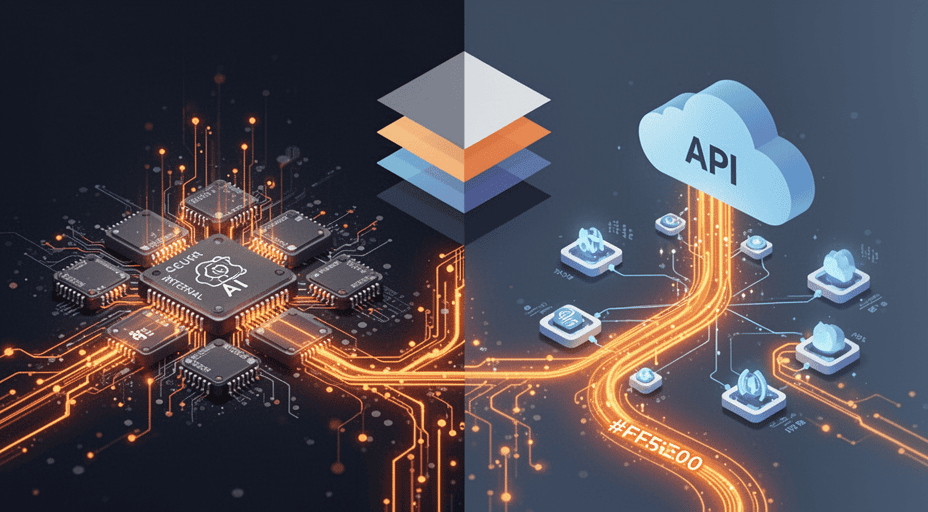
In 2025, a quiet paradox underlies the explosive growth of generative AI. IT departments still default to APIs as the natural gateway: whenever intelligence is needed, make a call—no need to think. Yet precisely in that year, the cost of inference for large language models has dropped below a threshold, making self-hosting open-source models on internal infrastructure no longer a distant fantasy. Crucially: most digital transformation plans still fail to reflect the reality that the split between internal models and the cloud is no longer a technical choice, but a nuanced economic decision.
At this crossroads, this article does not aim to provide an absolute answer. Instead, we will peel back each layer that constitutes the real value of an AI system, so each enterprise can accurately position itself on the on-premise vs. API spectrum. The analysis below is rooted in the physical operations of hardware, data structures, and real-world user behavior—not trend-driven speculation.
Separating Two Cost Mechanisms
Every calculation about where to run AI starts with one inescapable unit: the token. A token is the most discrete unit a language model processes—similar to a syllable or lexical fragment. When you send a prompt to an API, you pay per input and output token. When you run a model on your own server, you pay per GPU hour, regardless of how many tokens are generated. This is a structural difference.
The API model operates on purely variable costs per unit of work. More users mean more queries, and costs rise nearly linearly, with almost no ceiling. In contrast, on-premise models are dominated by fixed costs: a cluster of 4 to 8 H100 GPUs may consume hundreds of millions of Vietnamese dong monthly, regardless of query volume. The breakeven point lies where these two cost curves intersect. Below a certain daily token threshold, APIs are significantly cheaper. Beyond it, the fixed cost of self-hosting begins to amortize, and each additional token generates almost negligible incremental cost.
Key Takeaways: AI cost is not an absolute number; it’s a function of token volume. Enterprises must know their precise breakeven threshold before making a decision.
Beyond cash expenses, there’s a larger hidden cost: latency and network bandwidth. A text classification task requiring a 200ms response to integrate into a financial trading system suffers heavily from the physical distance to the API provider’s data center. Meanwhile, an on-premise model sitting next to the application server can reduce latency to just pure computation time. For enterprises operating on edge computing infrastructure, milliseconds determine whether the model is even feasible.
Three Pillars of the On-Premise vs. API Decision
To build a decision framework not driven by marketing, we reduce all factors into three fundamental components: computing resources, data characteristics, and adaptation frequency. These components interact and collectively determine the optimal deployment location.
Computing Resources: The Utilization Density Problem
A GPU, no matter how powerful, is wasted if it only runs 2 hours a day. Conversely, an API pipeline serving 10,000 concurrent users with traffic spikes during peak hours can balloon the monthly bill overnight. Therefore, the first factor to quantify is real-time utilization density—the distribution of token requests per hour, day, and business season.
If this graph is relatively flat and stable—typical for internal applications like administrative document processing or periodic report synthesis—an on-premise model can keep hardware utilized almost continuously. If the graph has sharp peaks—like a retail chatbot during a flash sale lasting only a few hours—APIs offer elastic scaling without needing to provision hardware for peak load.
Data: Where Core Value Resides
Data is the only non-copiable element in the AI chain that loses competitive edge if mishandled. A shared API model processes your prompt on the same GPU cluster as thousands of other enterprises. For most cases, the risk of data leakage at the application layer is negligible if the provider commits not to store data. However, for businesses whose prompts themselves contain sensitive competitive information—such as an unreleased product design, pricing strategy, or ongoing contract negotiation—sending that data through a third party creates an exposure point outside the internal security team’s control.
The issue isn’t just legal risk. It directly affects output quality. An internal model has full permission to fine-tune on proprietary data without contamination from external noise. A pharmaceutical company using a private model to predict drug interactions will achieve significantly higher accuracy compared to calling an external API, which cannot share specific biological characteristics of its patient cohort.
Adaptation Frequency: The Irregular Upgrade Cycle
API providers continuously release new model versions. For API users, upgrading often means just changing a parameter in the API call. In contrast, self-hosting enterprises must allocate technical cycles to download new models, prepare environments, and test compatibility. For businesses in markets where AI capabilities must be updated monthly to keep pace with competitors, APIs offer a lower-friction path.
However, there’s an underappreciated downside. When you rely on an API provider’s upgrade cadence, you’re also forced to adapt to changes in content moderation policies, output formatting rules, or the model’s safety philosophy. A corporate chatbot fine-tuned for consistent tone may suddenly change its style overnight simply because the base model was updated. Self-hosting grants absolute control over the model version, allowing a company to lock a stable snapshot for months without external interference.
Hybrid Model: Tiered Architecture by Decision Layer
Based on the above pillars, an effective hybrid architecture isn’t about choosing one over the other—it’s about routing tasks to the right environment based on their characteristics. This is how leading organizations are operating in practice.
High-Sensitivity Tier – On-Premise Only: Pipelines handling healthcare data, legal documents, proprietary source code, or internal financial analysis run entirely on private GPU clusters. Models used here are typically audited and sanitized versions of Llama 3, Mistral, or Qwen, deployed via vLLM or TGI to maximize throughput.
High-Variability Tier – API for Peak Loads: Customer-facing applications, especially call center chatbots or website virtual assistants, have unpredictable access patterns. They may receive dozens of requests on a normal day, then suddenly spike to hundreds of thousands during a marketing event. For tasks not involving core data, APIs act as an elastic buffer, absorbing all load beyond a threshold without requiring additional GPU purchases.
Mid-Tier – Intelligent Caching: This is where hybrid architecture reveals its real power. A small orchestrator (often a Python or Go service) receives all AI requests from applications. It checks a semantic cache. If a similar query has been answered before, the result is returned immediately—no model call needed. If not cached, the orchestrator classifies the prompt: if it contains sensitive keywords, it’s routed to the internal model. If it’s a complex, general question, it’s sent to the strongest API. If it’s a simple query, it’s sent to a smaller internal model to minimize cost.

Practical Insight: An orchestrator may sound complex, but it is often just an if-else logic built on two criteria: banned keywords and estimated token count. Most companies don’t need a commercial hybrid AI platform. A 200-line script written by the DevOps team is often more transparent and controllable than any off-the-shelf solution.
When a 3,000-Employee Enterprise Hits the Decision Point
Consider an electronics component manufacturer with about 3,000 internal employees, implementing a virtual assistant for technical process lookup and machine incident reporting. Initially, they used OpenAI API with GPT-4o. For the first six months, everything ran smoothly: an average of 8,000 queries per day, costing roughly 300–400 USD monthly. But in Q2 2026, after an internal training session, query volume suddenly spiked to 60,000 per day. The API bill climbed to 2,200 USD/month and kept rising.
The tech team began analyzing. They found over 70% of queries were repetitive: “How to restart CNC line X,” “What does error code E-452 mean,” “Safety guide for assembly area.” These questions rarely changed, as production processes were standardized annually. Furthermore, the internal process data was a trade secret; the company preferred not to send such data externally, especially since some questions inadvertently exposed real production capacity.
They decided on a hybrid model. A cluster of four A100 GPUs was leased at a domestic data center, running vLLM with a Llama 3 70B model fine-tuned on all internal documentation. All internal queries were routed here. For complex synthesis tasks like “Compare performance of two production lines this month,” the system automatically called the GPT-4o API with an anonymized prompt—removing specific metrics. Result: monthly costs dropped to around 1,100 USD (including server rental and backup API usage), latency decreased by 40%, and the legal team no longer worried about data leaks.
The key takeaway from this case study isn’t the cost savings. It’s that the enterprise correctly identified the frequency of knowledge change. When knowledge is nearly static, an internal model doesn’t need constant updates and becomes an efficiently amortized asset.
Comparison Table of Deployment Options
Before making a final decision, enterprises must evaluate all options on equal ground. Below is a comparison of three common models in 2025–2026.
| Criteria | OpenAI API (GPT-4o) | Anthropic API (Claude 3.5) | Self-Hosted (Llama 3 70B on vLLM) |
|---|---|---|---|
| Cost Structure | Variable, per-token pricing | Variable, per-token pricing | Fixed, per-GPU-hour pricing |
| Average Latency | 500–900 ms (over internet) | 600–1000 ms | 80–200 ms (within internal LAN) |
| Model Customization | Paid, limited fine-tuning | No broad fine-tuning support | Full, unlimited fine-tuning |
| Data Control | Data leaves internal infrastructure | Data leaves internal infrastructure | Data remains entirely internal |
| Handling Traffic Spikes | Automatic, no hard limits | Automatic, subject to rate limits | Limited by available GPU count |
| Model Updates | Provider performs automatic updates | Provider performs automatic updates | Enterprise manually upgrades |
| Version Stability | Not controllable | Not controllable | Fixed snapshot, long-term stability |
Expert Note: Don’t confuse “spike scalability” with “sustainable scalability.” APIs handle spikes excellently, but if spikes become the new normal, API costs will surpass hardware investment within just a few quarters.
Readiness Scorecard: When Is Your Business Prepared for On-Premise AI?
Below is a scoring system to quantify how suitable self-hosting is, based on real-world signals businesses can measure. Score from 1 (completely unsuitable) to 10 (extremely suitable).
| Criteria | Score | Notes |
|---|---|---|
| Daily token volume consistently exceeds 1 million | 7 | Below 1 million, APIs are usually cheaper |
| Data belongs to high-sensitivity or competitive security category | 9 | Legal requirement for internal handling |
| Model change frequency less than once every 6 months | 8 | Static models amortize hardware better |
| Requires under 200ms latency for core tasks | 9 | Hard for APIs to meet consistently over public internet |
| Has at least 1 ML engineer available for operations | 6 | Infrastructure management can be outsourced |
| Deep customization needed (full parameter fine-tuning) | 8 | APIs currently support only limited fine-tuning |
| Low tolerance for service interruption risk | 5 | On-premise may suffer outages; APIs typically offer higher SLA |
| Initial investment budget ready for at least 3 months | 7 | Needed to cover setup and testing phase |
Total Score: 59 / 80
Scoring guideline: 1–4 = low suitability—the enterprise should almost certainly continue using APIs and delay hardware investment. 5–8 = moderate—there are clear maturity signals; begin experimenting with a small internal model on an isolated task. 9–10 = ideal—failing to self-host AI now equates to wasting resources.
With a total of 59, the hypothetical company is clearly in the “moderate” range. This suggests a partial shift toward a hybrid model will bring clear benefits—but requires a cautious roadmap, starting with a small project and expanding as operational metrics stabilize.
18-Month Forecast: Quiet Shifts Reshaping the Game
From mid-2025 to end-2026, three shifts will directly impact the on-premise vs. API calculus, continually moving the boundary between the two.
First, inference cost per token on internal hardware is dropping faster than API pricing. New-generation GPUs like the H200 and specialized inference accelerators from NVIDIA or AMD increase throughput while reducing power consumption. At the same time, techniques like 4-bit quantization, speculative decoding, and continuous batching enable an 80GB GPU to serve hundreds of users in parallel. This pushes the breakeven point between API and self-hosting lower every quarter.
Second, smaller models are evolving to become “skilled workers”. Models with 7–13 billion parameters today can already handle narrow tasks like information extraction, intent classification, or contextual spelling checks. These models don’t require expensive GPUs; they can run on modern CPU servers with large memory. Enterprises can deploy dozens of small model instances on private cloud infrastructure at far lower cost than paying per API call for trivial tasks.
Third, API providers are gradually tightening usage policies and end-user identification. It’s increasingly common to see enterprise verification requirements, industry-specific rate limits, and price hikes for large-scale commercial use cases. This doesn’t mean APIs are becoming worse—it means the bargaining power of API-dependent businesses will weaken over time, while self-hosting enterprises retain absolute independence.
Key Insight: In the next 18 months, a smart AI strategy isn’t about choosing a side. It’s about building a flexible infrastructure capable of frictionlessly shifting workloads between on-premise and API based on real-time cost and risk signals.
The rise of orchestration platforms like LangChain, Haystack, or custom solutions built with FastAPI + Redis serves as the adhesive layer that enables such flexibility—without rewriting entire applications every time technology trends shift.
In summary, the debate of “on-premise vs. API” will quickly become outdated. What enterprises need to do today isn’t bet on one side, but establish a precise measurement system for three key metrics: daily token volume, maximum required latency, and data sensitivity level. With these three numbers, the answer will emerge naturally. No magic, no prophecy—only decisions anchored in real, operational data from the business itself.
Related Posts

Why the Business Models of AI Apps Like OpenClaw, Hermes, and MCP Platforms Are Driving a Shift from the App Economy to the Agent Economy?

Three Latest Data Attack Vectors on AI Systems That Every Business Owner Must Know Before Delegating Control to Open-Source Models

Can AI Self-Evaluation Radically Transform the Way We Monitor Systems?

What Are the Boundaries in Modern Production Processes When AI Agents Like Cline Can Read Codebases, Fix Bugs, and Automatically Deploy to Cloud Platforms?
Cost Revolution: Why New Generation AI Chips Make On-Premise the 'Gold Standard' in 2026?