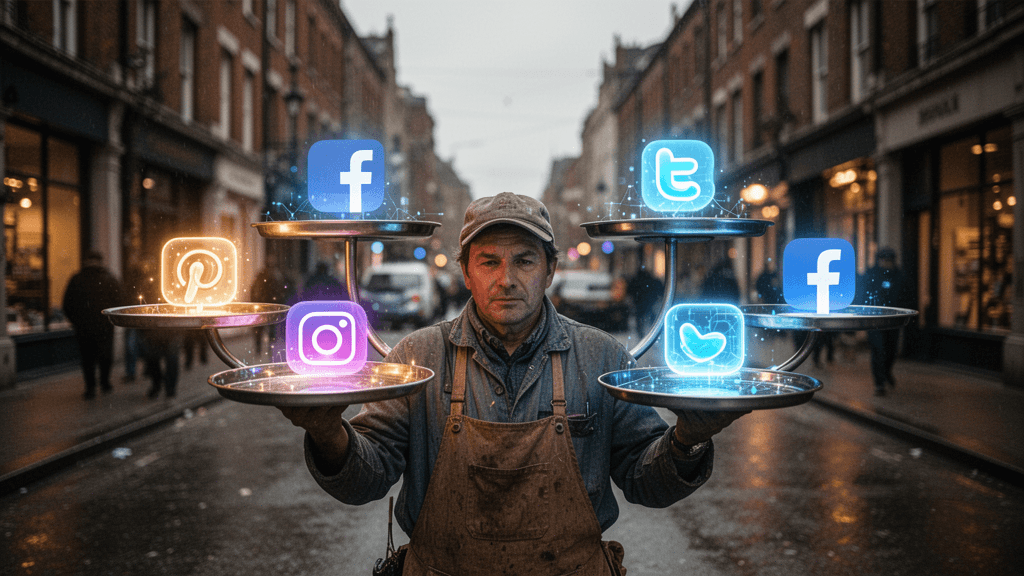
Is Social Media in 2026 Returning to a Connection Model Based on Interests Instead of Social Graphs?
I. Introduction & Context 2025-2026
We are living through one of the most silent yet intense transitions in the history of social media. The era of “Social Graph” (social graph—where connections are based on who you know) is gradually giving way to the “Interest Graph” (interest graph—where connections are based on what you like). By 2026, the user models of platforms like Meta or X (Twitter) will no longer be as decisive as those of TikTok or YouTube Shorts. Users will no longer care if someone is their friend or a family member.
Key Takeaways: In 2026, the algorithm does not care about real-world relationships (economic, family). It cares about the Vector Similarity (similarity of vectors) of your behavior and the content you consume.
This revolution is not the rise of new platforms but a “mutation” in content distribution mechanisms. Instead of seeing what your college friend posts, you will see content from a complete stranger who speaks directly to the issue you are exploring at 2 AM. This shift raises a significant question for Growth Hackers and Builders: How do you survive when “friends” are no longer an effective distribution channel?
II. Root Cause Analysis (Applying First Principles)
To understand this trend, we need to strip away all marketing layers and look at the underlying operations. We need to apply First Principles thinking: What is the most basic structural unit of social media?
1. The Failure of Dunbar’s Number in the Digital Age
The social graph is based on the biological limits of the human brain. Humans can only maintain about 150 stable social relationships (Dunbar’s Number). However, modern social media has tried to expand this number to thousands. As a result, the Noise-to-Signal Ratio (noise to signal ratio) has become extremely high. When you follow 2000 people, your feed becomes a chaotic stream of information that the brain cannot process. Platforms have recognized that displaying content from “friends” quickly leads to boredom (boredom).
2. From Graph Traversal to Vector Search
Previously, Facebook used Graph Traversal (graph traversal): You like A’s post -> You see A’s posts. This was a static relationship-based logic. By 2026, everything will shift to Vector Search in multi-dimensional space. Each post, each video is encoded as a vector (a sequence of numbers). Your behavior is also a vector. The algorithm doesn’t look for “your friend,” it looks for the “vector closest to your current behavior vector.”
Expert Note:
Don’t mistake Interest Graph as just “interest groups.” It is a decentralized mapping between User Intent (user intent) and Content Semantics (semantic content) through Embeddings.
3. Core Issue: Dependence on the Creator Graph
When shifting to the Interest Graph, power shifts from the Social Graph (ordinary users connecting with each other) to the Creator Graph (content creators connecting with algorithms). Social media in 2026 is essentially a massive marketplace where Attention (attention) is the currency, and the Interest Graph is the machine that is a hundred times more efficient at minting this currency than the Social Graph.
III. Detailed Execution Strategy
This is the most crucial part. To navigate or build products in the 2026 Interest Graph era, you cannot just “post good content.” You need a clear strategic framework.
1. Redefining Content Strategy: From Broadcast to Semantic Matching
In the past, you wrote statuses for friends to read (Broadcast). In 2026, you write content for machines to read, and then machines bring it to people with similar interests (Semantic Matching).
Execution Strategy:
- Keyword-First Writing: Use high-semantic keywords (Semantic Keywords) in the caption, even in the speech-to-text of videos. TikTok and Google Lens in 2026 have the capability to index video content based on objects and sound.
- Topical Authority: Instead of posting randomly (life vlogs, cooking, code mixed together), focus on building a channel deeply specialized in a niche (Vertical Niche). The Interest Graph algorithm needs clean data to label your profile as an expert in a particular field.
2. Optimizing for “For You” (FYP) Instead of “Following”
By 2025-2026, the “Following” tab on most platforms will either be removed or buried deep. Users will primarily stay on the “For You” or “Discover” tabs.
How to Implement:
- Hook Strategy: The first 3 seconds determine whether the algorithm will push your content into a new Interest Graph. Low retention means your content will die in the current Interest Graph (limited reach).
- Interleaving Strategy: Interleaving content. If you focus on AI, interleave between tutorials, news, and opinions. This helps the algorithm determine the breadth of the Interest Graph you can reach.
Expert Note:
Don’t try to hack the algorithm with fake interactions. In 2026, bot detection systems using Behavioral Biometrics (behavioral biometrics) are extremely sensitive. Focus on Real User Retention.
3. Building Community Based on Topics, Not People
This is the biggest change in the operational model of communities.
Old Model (Social Graph): Group “Close Friends from High School.” People talk about everything. Very noisy, little valuable information. New Model (Interest Graph): Channel “Prompt Engineering Techniques for Llama 3.” Members don’t know each other or are not friends, but they deeply interact because of the content.
Execution Strategy for Brands:
- Shift from “Fanpage” (where users like to express themselves) to “Topic Hub” (where users follow to learn).
- Use integrated Newsletter features (like Substack on X or Notes on LinkedIn) to send in-depth (deep-dive) information to the audience segment with the highest Interest Score.
4. Utilizing AI Agents as Intermediaries
By 2026, each user will have a Personal AI Agent. This agent will browse the web on behalf of the user. It will not care about ads based on social graphs. It will only care: “Does this content solve a problem for my owner?”
Impact on Content:
- Content must have high Utility (usefulness) or Entertainment Value (entertainment value). Vague, abstract posts will be immediately filtered out by AI Agents.
- Content structure must adhere to standard Schema Markup to make it easy for AI Agents to scan and summarize.
5. Data Analysis: Shifting from Metrics to Vector Clusters
Don’t focus on the number of followers. That’s a metric of the Social Graph.
Execution Strategy:
- Use analytics tools to see where your Interest Clusters (interest clusters) lie. For example, is your video going viral in the “Marketer” cluster or the “Developer” cluster?
- Cross-Platform Pollination: Place a video from YouTube (academically oriented) on TikTok (entertainment-oriented) but keep the semantic core intact. The goal is to measure how the Interest Graph of that topic reacts on different platforms.
IV. Comparison Table and Effectiveness Evaluation
To clearly visualize the differences, we will compare two approaches in the context of 2026.
Table 1: Comparison of Distribution Solutions/Tools
| Criterion | Social Graph Based (You, FB) | Interest Graph Based (TikTok, YT Shorts) |
|---|---|---|
| Distribution Mechanism | Based on relationships (Follow, Friend connections). | Based on behavior and semantics (Algorithmic matching). |
| Target Audience | Known, connected individuals (Warm Audience). | Complete strangers but with shared interests (Cold Audience). |
| Content Lifespan | Short (dies quickly in News Feed). | Long (can be revived months later through search). |
| Growth Barrier | High (requires building a network gradually). | Low (a single viral post can change the entire channel). |
| Content Nature | Personal, status updates (Life updates). | Informational, entertainment, knowledge (Vertical content). |
Table 2: Interest Graph Model Evaluation Scorecard
Below is an evaluation of the effectiveness of fully transitioning to an Interest Graph for a B2C brand in 2026.
| Criterion | Score | Notes |
|---|---|---|
| Feasibility | 7 | Requires high-quality content and frequent posting. |
| Cost | 4 | Higher production costs compared to writing text. |
| Virality | 9 | Potential to reach millions of people, unrestricted by friend lists. |
| Conversion Rate | 6 | High traffic but low purchase intent (Cold traffic). |
| Sustainability | 8 | Not dependent on algorithm changes that affect friend list reach. |
| Market Resilience | 5 | Risk of rapid trend changes. |
Explanation of Total Scores:
- 1-4 points (Low): The low scores in cost and market resilience indicate that this is an expensive and risky endeavor without a solid content strategy.
- 5-8 points (Moderate): Most scores fall in this range, suggesting that the Interest Graph model is “Moderate” to “Very Good” for brand awareness.
- 9-10 points (Excellent): The high virality score of 9 confirms that this is the only way to achieve rapid scale in 2026.
Key Takeaways: Despite the high costs and trend risks, the unlimited reach potential (9 points) makes the Interest Graph a mandatory choice for anyone aiming for large-scale growth.
V. Future Trend Forecast & Conclusion
Looking back, we realize that 2026 is not the end of person-to-person connections but a redefinition of “people we want to connect with.”
Forecast:
1. Private Social Graphs will exist but shrink:
- Social Graphs will retreat to the form of “Private Communities” (closed groups, Discord, iMessage) to serve deep communication needs, while Interest Graphs will serve the need for public content consumption.
2. Search-Based Social:
- Social media will become a search engine. You will search for “How to fix a React bug” on TikTok before searching on Google. The Interest Graph is the ranking engine for this.
3. Semantic Social:
- Platforms will categorize content based on meaning (semantics) rather than just hashtags or text.
Conclusion
The question “Is social media in 2026 returning to a connection model based on interests instead of social graphs?” has an answer that is NOT JUST “returning,” BUT “redefining.”
The Interest Graph of 2026 is a more evolved version, driven by AI and Machine Learning. It eliminates the waste of time on meaningless social relationships in the digital world and focuses resources on the core value: Relevant information reaching the right person at the right time.
For strategists, the message is clear: Stop nurturing “friend count.” Start nurturing “interest alignment.” The future belongs to those who understand their customers’ interests better than the customers themselves.
Related Posts

Why the Paid Challenge Model in 5-21 Days Has Become the Optimal Strategy for Solo Creators to Turn Expertise into Ongoing Revenue?

Automation vs. Authenticity: Analyzing the Strategy for Maintaining Authentic Interactions in the AI Era
Breaking Down Subscription Business: From Creator Economy to Super-Community

Building the Endless Video Machine: Dominating Multi-platform Automation Strategy in 2026

How a Single Individual Can Build Passive Income of $5,000–$50,000 Per Month by Combining Paid Communities and Paid Challenges