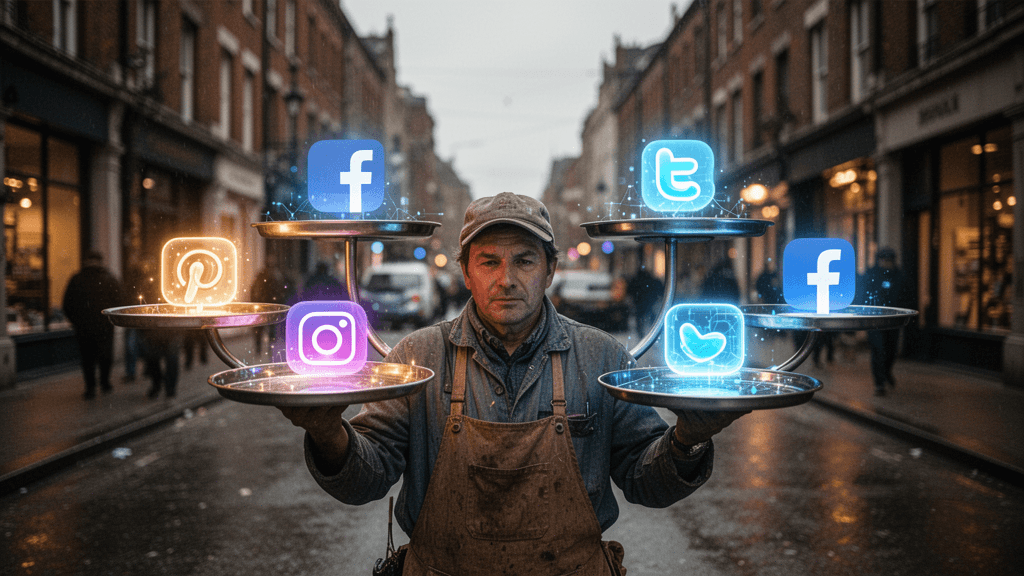
What is Driving the Wave of Creators Leaving Large Platforms to Build Communities on Separate, Controlled Channels?

I. Introduction & Context 2025-2026
We are witnessing a structural shift in the Creator Economy. It’s no longer a battle for Views or Likes. It’s a war for customer relationship ownership.
By 2026, the algorithms of large platforms have become saturated with AI-generated content. The noise-to-signal ratio has reached alarming levels. As all content can be automatically generated, the value of “authentic connection” has become the scarcest asset.
The wave of creators leaving “Rented Land” like Facebook, TikTok, or Instagram to build “Owned Land” such as Newsletters, Discord, or Personal Platforms is no longer a passing trend. It is a survival strategy. Creators realize that building an empire on someone else’s land places their entire business in the hands of an uncontrollable “Black Box” algorithm.
This article will dissect this issue from a First Principles perspective: breaking down the problem to uncover the root causes and providing a detailed implementation strategy.
II. Root Cause Analysis (Applying First Principles)
To understand the “why,” we need to peel back the layers of surface phenomena. Let’s look at the operating mechanisms of two models: Social Platform vs. Owned Platform.
1. Structural Mechanism: Rented vs. Owned
On large platforms, you are a “free content provider.” The platform is the “intermediary.” Their goal is to maximize Time on Site. Their algorithms are not designed to serve your interests but to serve advertisers.
When you build your own channel (Website, Email list, Community), you cut out the middleman. A direct relationship between Creator and Fan is established without going through a Feed or Algorithm.
Key Takeaways: Social Platform is a rental term, Owned Platform is a liquid asset. The difference lies in the control over Data (data) and Distribution (distribution).
2. Reach Issues and Organic Decay
By 2025-2026, Organic Reach (organic reach) on large platforms has almost dropped to zero for non-paying accounts. The logic is straightforward:
- Input: You post.
- Black Box: Algorithm evaluates (anonymously).
- Output: Displays (or does not display) to Followers.
You never know why Post A is seen while Post B is buried. This lack of transparency poses a long-term business risk. If the platform changes its algorithm today, your revenue could vanish tomorrow.
3. Economic Motivations: LTV vs. Viral
Viral (viral) brings reputation, but LTV (Lifetime Value - customer lifetime value) brings cash flow. Large platforms encourage Viral. Independent channels encourage LTV.
When you own your channel, you can track the user journey from Awareness -> Purchase -> Advocate. You cannot do this deeply if you rely solely on third-party black-box Analytics tools.
III. Detailed Implementation Strategy
This is the most crucial part. Theory is someone else’s; implementation is yours. Below is the roadmap for transitioning from Rented Land to Owned Land in the context of 2026.
1. The Bridge Strategy
Never delete your social channels to move to an independent channel. That’s self-sabotage. Use large platforms as a bridge.
Step 1: Define “Lead Magnet” (Lead Magnet). Users don’t join your community just for “love.” They join because there is a benefit. You need something of value to exchange for an Email/Subscription.
- Expert Tip: The Lead Magnet of 2026 should not be a PDF eBook that eats up storage. It should be a Tool, a Notion Template, or a Mini-course that can be accessed instantly.
Step 2: Create a Friction Point (Point of Friction). Place a Call to Action (CTA) on your Bio, Posts, and Stories. Use strong phrases: “Join the waitlist,” “Get the blueprint.” Don’t use vague terms like “Link in bio.” Provide a specific reason for them to click.
2. Tech Stack Selection (Technology Stack)
Don’t try to build an App from scratch if you don’t have a technical team. Use No-code tools.
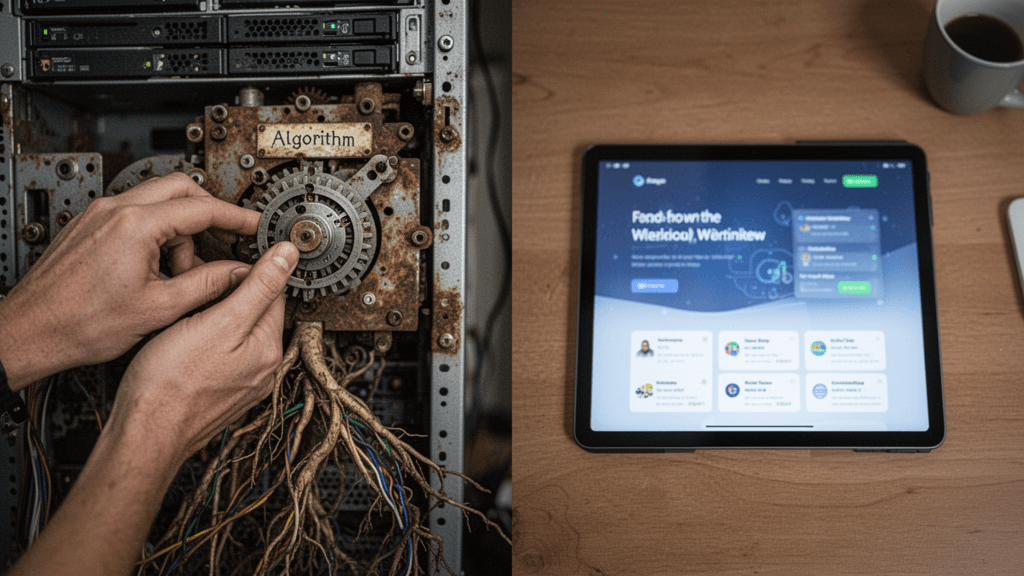
- Landing Page: Use Webflow, Framer, or Carrd. Page load speed must be under 2 seconds.
- Community Hub:
- If text-based: Discord (needs bots for management), Slack (formal), or Circle (optimized for creators).
- If course-based: Skool, Kajabi.
- CRM & Email: ConvertKit, Beehiiv, or MailerLite.
Key Takeaways: The Tech Stack should simplify. Don’t get caught up in selecting the “best” tools. Choose the easiest to integrate. The goal is Speed to Market (speed to launch).
3. Content Architecture
You need to clearly divide your content between Public and Private.
- Public Content (Rented Land): Use to Trigger (activate) and Attract (attract). Talk about the problems and pain points of your audience. This is Marketing.
- Private Content (Owned Land): Use to Solve (solve) and Transform (transform). Provide detailed processes, case studies, and one-on-one support. This is the Product.
Expert Tip: Never post all your best content publicly. Use the 80/20 rule. Keep 80% of the value for your independent channel to create a sense of “Exclusivity” (exclusivity).
4. Onboarding Process
The first interaction determines whether they stay or leave.
- Automation: Use Zapier or Make to automate the flow. When they log in -> Send a welcome email -> Invite to Discord -> Assign Role.
- Welcome Sequence: A series of 3-5 emails in the first week.
- Email 1: Thank you + Guide document.
- Email 2: Introduce community rules.
- Email 3: Call to action (e.g., Introduce yourself).
5. Monetization Mechanics
On your independent channel, you don’t earn from Ad revenue. You earn from Subscriptions, Memberships, or High-ticket sales.
- Freemium Model: Free access to the general channel, paid access to VIP Channel.
- Value-Add Model: Sell courses, workshops, or consulting directly within the community.
Implementation Strategy: Prices must be clearly listed. Don’t be afraid to offend those who don’t pay. Studies in 2026 show that users are willing to pay over three times more for ad-free, highly interactive content.
IV. Comparison and Evaluation Table (Scorecard)
To help you visualize the differences and effectiveness of the solutions, here is a detailed analysis table.
Table 1: Comparison of Platform Solutions for Creators
| Criterion | Social Platforms (TikTok/IG) | Newsletter Platforms (Beehiiv/Substack) | Community Platforms (Skool/Circle) |
|---|---|---|---|
| Ownership Type | Rented (Rented) | Owned (Email List Ownership) | Owned (Member Data Ownership) |
| Algorithm | Black Box (Controlled by Platform) | Push (Regular, 100% Inbox) | Pull (Members must actively engage) |
| Interactivity | High but Shallow (Shallow Engagement) | Low but Deep (Deep Reading) | Very High and Deep (Networking) |
| Primary Revenue Source | Brand Deals, Ad Share | Subscription, Ads | Membership, Course Fees |
| Platform Risk | Very High (Easy to be Banned) | Low (Can take emails elsewhere) | Medium (Dependent on third parties) |
| Scalability | Extremely Fast | Average | Slow but High Quality |
Table 2: Scorecard for Evaluating the Strategy to Transition to Owned Channel
Below is a scoring table for transitioning from Social to Owned Channel for a professional Creator in 2026.
| Criterion | Score | Notes |
|---|---|---|
| Technical Feasibility | 9 | No-code tools are very mature, easy to set up. |
| Initial Operating Cost | 7 | Software costs but cheaper than running Ads. |
| Initial Growth Speed | 3 | Very slow compared to Viral on Social, requires patience. |
| Long-term Sustainability | 10 | Owning data helps sleep better at night. |
| Monetization Potential | 8 | Easy to upsell high-value services. |
| Community Interactivity | 9 | Safe environment, no spam bots. |
| Automation Capabilities | 8 | Good integration with AI Agents for management. |
| Summary | 7.7 | Good |
Explanation of the Scoring Scale:
- 1-4 points: Low - High-risk strategy, poor effectiveness, not recommended.
- 5-8 points: Good - Feasible strategy, challenging but brings stable long-term benefits. This is the score of most successful channel transition strategies.
- 9-10 points: Excellent - Optimal strategy, brings significant profit and brand value immediately.
Thus, the transition to an Owned Channel scores Good to Excellent in key criteria of long-term sustainability and monetization potential, despite initial challenges in growth speed (Score 3).
V. Future Trends & Conclusion
Looking ahead, the line between “Creator” and “Entrepreneur” will completely blur. In 2026-2027, we will see the rise of “Personal AI Agents.” Each Creator will have an AI Clone to manage their own community, respond to comments, and provide basic advice on owned channels.
The trend of “Micro-Communities” (small communities) will rise. Instead of having 100,000 anonymous followers, Creators will aim for 1,000 high-paying members. Quality will surpass quantity.
Conclusion:
Leaving large platforms is not an emotional choice. It is a mathematical decision.
- Input: Algorithm instability, AI content competition.
- Process: Build your own infrastructure, collect first-party data, establish direct relationships.
- Output: Sustainable business asset, high cash flow, and true freedom.
Don’t build your empire on someone else’s sandy ground. Start laying the first brick in your own garden today.
Key Takeaways: Control is the new currency. In the world of algorithms, audience ownership is the only non-replicable competitive advantage.
Related Posts

Why the Paid Challenge Model in 5-21 Days Has Become the Optimal Strategy for Solo Creators to Turn Expertise into Ongoing Revenue?
Automation vs. Authenticity: Analyzing the Strategy for Maintaining Authentic Interactions in the AI Era
Breaking Down Subscription Business: From Creator Economy to Super-Community
Building the Endless Video Machine: Dominating Multi-platform Automation Strategy in 2026
How a Single Individual Can Build Passive Income of $5,000–$50,000 Per Month by Combining Paid Communities and Paid Challenges