Why Large Enterprises Are Returning to Code After Years of Low-Code Automation Hype?
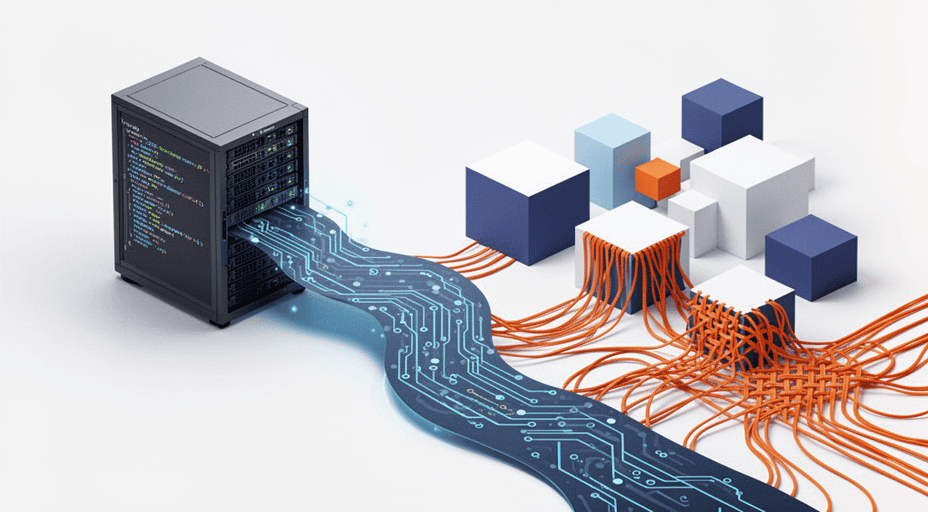
Looking at the digital transformation landscape in 2025, a quiet paradox is playing out in the tech rooms of top-tier corporations. After nearly a decade of investing millions into drag-and-drop platforms, CTOs are quietly approving budgets for traditional software development teams. They are rehiring Java, C#, and React engineers. They are reopening repositories once deemed outdated legacy systems. This isn’t a religious war between “code” and “no-code” camps. It’s a cold economic calculation where the hidden costs of convenience have finally exceeded the system’s tolerance threshold.
The Sweet Trap of Simplification
When a low-code platform promises business staff can build applications without writing a single line of code, it taps into a primal managerial desire: reducing dependency on IT, traditionally seen as a bottleneck. The underlying mechanism of these platforms is essentially a network of pre-packaged functions. Every time you drag a “Send Email” or “Create Record” block, you’re not programming—you’re activating a hardcoded sequence of XML or JSON commands authored by the platform provider.
The problem is, these packaged functions are designed for the masses. They are like standard Lego bricks. When you’re building a house with conventional shapes, everything works quickly. But when a corporate business process requires a 15-degree curved wall, you instantly have to saw, patch, and ultimately shatter the original brick to force in a custom code snippet.
Key Takeaway: Low-code doesn’t eliminate code. It locks code inside a black box for which you don’t hold the key. When the black box breaks, you’re worse off than in the beginning—even the internal structure is incomprehensible.
Three Unfixable Cracks
The failure of a large-scale automation project rarely lies in the user interface or features. It occurs in three core mechanisms that low-code platforms handle with startling naivety.
The Lifecycle of a Data Unit
In enterprise environments, data doesn’t sit still. It flows through dozens of intermediate systems. When a contract is signed on DocuSign, it must be parsed into accounting entries, updated in the CRM, trigger HR workflows, and synchronized with a data warehouse. Low-code platforms handle this via static API connectors. Each connector is a rigid, pre-cast pipe.
The fatal flaw occurs when the CRM’s output format changes just one field—say, from CustomerName to FullName. In a traditional code architecture, you’d modify a single mapping line. In a low-code environment, if the platform doesn’t support low-level error handling, the entire automation flow silently collapses, generating ghost data records that go unnoticed until end-of-period financial reconciliation.
Conditional Logic and the Complexity Paradox
Business workflows don’t operate on “if true then proceed; if false then stop” rules. They follow logic like: “If true, and it’s Q3, and the customer is VIP, and the exchange rate exceeds 25,000, then approve; otherwise, route to manual review—but send an alert to the regional director.”
When displayed on a drag-and-drop interface, this logic becomes a tangled web of arrows, diamonds, and branching conditions—a visual spaghetti code. Cognitive psychology research shows the human brain handles sequential, text-based logic (code) far better than complex 2D spatial diagrams. Beyond a certain complexity threshold, reading a 50-line switch-case statement becomes more intuitive than untangling a canvas bloated with 50 blocks.
The Marginal Cost of Scaling
This is the most overlooked factor in initial TCO calculations. In native code systems, the marginal cost of the 1,000,001st user is nearly zero. Server infrastructure increases by a few dollars; the codebase remains unchanged. Most low-code platforms bill per end-user, per automation run, or per processed data volume. As large enterprises scale from 100 to 10,000 employees, costs don’t rise linearly—they explode exponentially, while performance declines due to bloated, multi-layered architectures.
Scenario Simulation: Order Management System at Demeter Corp
Context
Demeter Corp, a mid-sized agricultural supply chain enterprise, decided in 2023 to digitize its fresh produce order processing. They chose a leading low-code platform to build their Order Management System, enticed by the promise of “launch in 3 months, no coding required.”
The initial process was simple: Orders from e-commerce platforms → classified by delivery region → routed to corresponding cold storage → automated invoicing.
Catalyst for Collapse
In Q2 2025, Demeter introduced a new policy: If the outdoor temperature in the delivery region exceeds 38°C, orders must automatically incur a premium cold-storage fee, switch from refrigerated trucks to freezer trucks, and reduce delivery time by 30% to prevent spoilage.
On the low-code platform, this required:
1. Calling a third-party real-time weather API (incurring additional connector licensing).
2. Creating a complex decision table with three dynamic variables: temperature, humidity, and product type.
3. Overriding default warehouse routing logic to assign freezer trucks.
The operations team spent four weeks struggling with the drag-and-drop interface but kept hitting a “Race Condition” bug: When temperatures fluctuated right around the 38°C threshold during server processing, orders were either double-billed or not charged at all.
The “Return to Raw Materials” Solution
By late 2025, Demeter’s CTO ordered the module removed from the low-code platform. They rewrote the entire processing flow in pure Python using an asynchronous event loop (asyncio). The entire complex logic was condensed into a clean Python function under 100 lines, containerized with Docker, and deployed on an internal Kubernetes cluster.
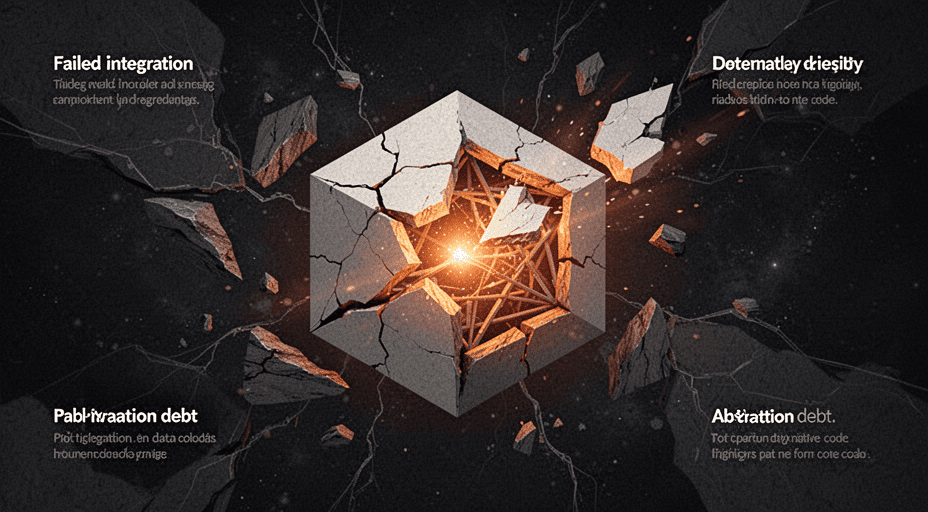
Result: Processing speed quadrupled, and the Race Condition was completely eliminated via an idempotency key mechanism in code. They kept the low-code platform only for building reporting dashboards for managers, but the core business logic had been decisively “repatriated” back to code.
Composite Architecture: The Operating Model for Large Enterprises
From this case, the essence of corporate digital infrastructure is not a binary choice between code and low-code. It is a data-flow-based layered architecture.
Look clearly at how a single bit of data travels through a corporation. It passes through three stages: Ingestion, Transformation, and Distribution.
Using low-code at the Ingestion stage makes sense—where you need fast connections to standardized third-party APIs. Using it in Distribution is also acceptable when business users need to self-serve report dashboards.
But the Transformation stage—where core business logic runs, where money is made or lost—demands absolute precision and byte-level control. At this stage, data must be transformed by algorithms whose mathematical logic you can “touch” down to the last bit, something black-box low-code platforms cannot offer.
Code, in its most primal form, is a set of logical instructions executed directly by the CPU, unmediated by any interpretive translation layer that might arbitrarily reinterpret them. That is the fundamental difference.
Execution Strategy: Defining Critical Boundaries
Returning to code doesn’t mean firing all low-code operations staff or launching a technological crusade. That would be a strategic blunder. The pragmatic approach lies in redrawing boundaries based on the system’s entropy characteristics.
Invariant vs. Variable Systems
Every organization has processes with low entropy—those that rarely change. Examples: Leave request processes, employee ID generation, internal notifications. These are safe zones for low-code: convenience is maximized, error risk minimized.
In contrast, processes with high entropy—constantly changing due to market shifts, promotions, or tax regulations—must be mapped to native code at all costs. Dynamic holiday pricing logic, inventory allocation algorithms during supply chain disruption, or fraud detection rule engines belong here. These are the competitive heartbeats of the business. Placing that heart inside a machine whose circuit diagram you don’t understand is a gamble with high odds of losing.
Critical Note on Reverse Migration
When pulling an application from a low-code platform back into code, businesses often get stuck on data. Low-code platforms frequently store data in proprietary databases, making data export a nightmare for data integrity. A mandatory “dual maintenance” phase (running both old and new systems in parallel) is required until every record is verified for consistency.
Platform Capability Comparison in Enterprise Environments
Not all low-code platforms are created equal. The key difference lies in how much low-level access they permit.
| Technical Feature | Pure Low-Code (Enterprise) | Hybrid Low-Code (With Code-First Backend) | Native Code Model (Microservices) |
|---|---|---|---|
| Error Handling Mechanism | Platform’s default dialog boxes | Partially customizable via webhooks | Full control over Exception Handling |
| Speed for Large-Scale Data Processing | Limited by provider’s API Gateway | Depends on custom-built backend architecture | Linear with allocated hardware resources |
| Version Management (Versioning) | Almost non-existent, manual rollbacks | Git-based, but UI bindings may break | Full DevOps-standard CI/CD pipeline |
| Marginal Cost (at 10K users) | Very high, charged per block or seat | Moderate: platform + infrastructure fees | Low, primarily server operational costs |
| Portability (Vendor Lock-in) | Near-total lock-in | Partial, with external logic layer | Fully flexible, runs on any cloud |
Readiness Scorecard for Code Reversion
Before deciding to rewrite anything, enterprises must score the suitability of their current system. Below is a self-assessment scorecard for a complex order management system (similar to the case study above).
| Criterion | Score | Practical Notes |
|---|---|---|
| Complexity of business rules (1–10) | 9 | Too many dynamics involving temperature, timing, and pricing. Exceeds drag-and-drop configurability. |
| Frequency of core logic changes | 8 | Operational policies shift with seasons. Code is easier to modify and test than tangled canvas arrows. |
| Data error control capability | 7 | Order data is financial core. A small error causes revenue loss. Hard idempotency mechanisms are essential. |
| Dependency on vendor | 10 | Currently fully locked-in. No pricing negotiation power at scale. Liberation is critical. |
| Internal technical team capability | 6 | Team can write Python well but is unfamiliar with DevOps. Needs ramp-up time. |
Average Score: 8.0 / 10 (Good, but trending toward urgent need for migration).
With this score, Demeter Corp’s decision is fully justified. They weren’t technology zealots. They were skilled risk managers. The only real risk—the team’s capability (6 points)—was manageable by hiring one senior developer or upskilling internally. In return, they completely eliminated the critical “vendor lock-in” risk (10 points) and regained control over high-volatility logic.
Signals from the 2026 Horizon
Large enterprises returning to code is not the end of the low-code industry. That sector will continue to thrive, especially in SMEs or non-core departments. But in the top tier of the market—where data is measured in petabytes and business logic changes by the minute—a clear power shift is emerging.
Software architects in 2026 are elevating the concept of automation to a new level. They no longer ask, “How can I run this without code?” Instead, they ask: “How can code become the final shield, protecting data from the chaos of automatic processes?”
New platforms will be forced to expose their core. The trend of “Headless Automation”—where platforms provide only powerful APIs, and the drag-and-drop interface is merely an optional client—will rise. This allows enterprises to retain the surface speed of low-code while maintaining firm control over the underlying code spine. The battle is no longer “low-code kills code,” but “code domesticates low-code to serve its purpose.”
An organization’s technological maturity is measured by its ability to distinguish between wanting something to work right now and wanting it to keep working without failure in an environment where every parameter could be overturned tomorrow. This isn’t a war between tools. It’s a war between short-term convenience and long-term survival—and large enterprises are waking up, choosing to stand on the side of endurance.
Related Posts

10x Growth: The Secret to Scaling with Automation for Businesses in 2026
2026 Trend: Low-Code Platforms Will Dominate SMEs Before Custom Solutions Can Mature

Why the Paid Challenge Model in 5-21 Days Has Become the Optimal Strategy for Solo Creators to Turn Expertise into Ongoing Revenue?

How to Build an AI Native Automation Strategy Instead of Just Connecting APIs?

Why the Business Models of AI Apps Like OpenClaw, Hermes, and MCP Platforms Are Driving a Shift from the App Economy to the Agent Economy?