Why the Smartest Content Creator Strategy in 2026 Isn't Chasing New Platforms, But Building a Platform You Truly Own?

I. Introduction & Context 2025-2026
We are entering a chaotic era of digital content. The landscape of 2025-2026 is no longer a game of “who has the most views” but has shifted to “who owns the deepest relationships.” AI has created an endless wave of content, making user attention more scarce than ever.
Traditional social media platforms like Facebook, TikTok, or LinkedIn are changing their algorithms every day. They prioritize content that keeps users within the platform (retention) over helping creators connect with their audience. This is the harsh reality that every creator must face.
While the majority of the crowd is still following new trends like Shorts, Threads, or other short-form video platforms, strategic thinkers have shifted their focus. They realize that building a distribution channel that they truly own (Owned Platform) is the only real asset.
II. Root Cause Analysis (Applying First Principles)
To understand why chasing new platforms is a trap, let’s apply First Principles thinking. We need to strip away all assumptions and look at the core of the issue.
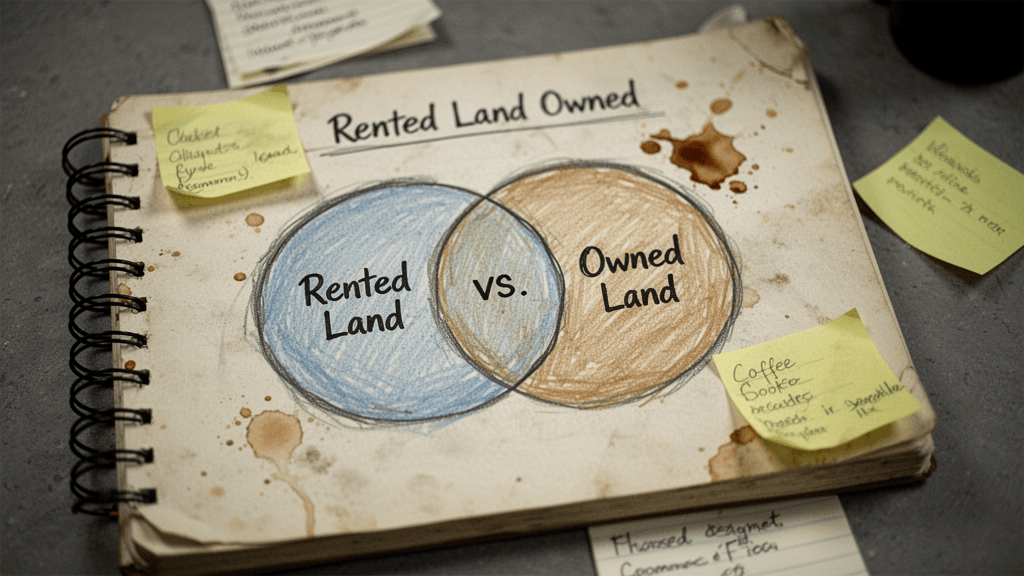
1. The Essence of Rented Land vs. Owned Land
Social media is “rented land.” You build your house on someone else’s land, follow their rules, and they can reclaim the land at any time without compensation. The algorithm is a black box with no transparency.
An owned platform (Owned Platform) is “buying land.” This could be a website, an email list, a private community (like your own Discord server or a user-data-driven group), or a product. You have complete control over the rules and how you approach your audience.
Key Takeaways: When you rent land, you are a product of the platform. When you own the land, the customer is your asset.
2. Distribution Mechanisms in the AI Era
In 2026, AI Agents will start replacing humans in information seeking. Instead of scrolling through Newsfeeds, users will ask their Personal AI: “Find me the best healthy recipe for today.”
If your content is locked behind the algorithm of a third-party platform, AI will find it difficult to access and recommend it. Conversely, if you have a website with standard SEO data structure and an open API email system, AI can easily index and serve your content to users.
3. Unit Economics
Chasing new platforms requires you to continuously learn new UIs, new content formats, and new algorithms. The opportunity cost (Opportunity Cost) is enormous.
The cost of attracting 1,000 new followers on a new platform is very high in terms of time. In contrast, sending a message to 1,000 people already in your email list has a cost that is nearly zero.
III. Detailed Implementation Strategy
This is the core section. Instead of just theory, we will go through each specific step to build your owned empire. Imagine you are building a backend system for an application; your content is the API.
1. Establish the Command Center: The Home Base
Your website is no longer a static online magazine. It must be a “Conversion Engine.” This is not just a place to display content, but also to collect data.
Expert Note: Avoid slow drag-and-drop web builders like Wix or Squarespace if you want to optimize speed and SEO for AI. Use static frameworks like Astro, Next.js, or Hugo combined with a Headless CMS.
Your website should focus on three key factors:
- Core Web Vitals: Lightning-fast loading speed.
- Data Capture: Opt-in forms everywhere (Pop-ups, Inline, Exit-intent).
- Indexability: Standard Schema Markup structure for easy reading by Google AI and other agents.
2. Building the Gold Mine: First-Party Data Collection
Email marketing in 2026 is not about sending spam. It’s about delivering value. The goal is to convert your audience from “cold” (cold) on social media to “warm” (warm) in their inbox.
Implementation Strategy:
- Smart Lead Magnets: Don’t just give away an ebook. Offer a tool, template, or interactive mini-course. For example, a ROI calculator or a Notion checklist.
- Double Opt-in: Use double opt-in to ensure a high-quality list and avoid the spam folder.
- Segmentation: Tag users based on their interests from the start. If they download content about “SEO,” tag them as “SEO Interest.” When you sell an SEO course later, you can simply email this group.
3. Repurposing Content for Your Owned Platform
Many people mistakenly think a website is just for long 2000-word blog posts. This is incorrect. To build a successful owned platform, you need to diversify the format while keeping everything on your server.
- Newsletter: Convert content from LinkedIn/X into a weekly newsletter. This is your “flagship” product.
- Self-Hosted Podcast: Don’t just upload to Spotify. Host your MP3 files on your server and distribute via self-managed RSS. You own the listener data.
- Private/Protected Video: Upload videos to your own platform (Vimeo Pro, Bunny.net, or AWS S3) and embed them on your website. Lock content for paid members. Don’t rely on YouTube Premium Revenue.
Key Takeaways: Social media is just a marketing channel to drive traffic to your Home Base. Never consider it your primary asset repository.
4. Automate the Process with No-Code/Low-Code
To manage this system without a large technical team, you need the help of automation.
Example Automation Workflow:
1. User leaves their email on your website.
2. System automatically sends a welcome message + link to the lead magnet.
3. System automatically adds the user to the “New Lead” segment on your CRM.
4. Chatbot (based on your AI) automatically sends a small survey to understand the user better.
5. Survey data is updated in the user profile for personalized email campaigns.
Expert Note: Use tools like Make or Zapier to connect your email tool (like ConvertKit/Beehiiv) with your database (Airtable or Google Sheets). This is how you build your own “Customer 360 view” that Facebook will never show you.
5. Direct Monetization: Cutting Out the Middleman
When you own the platform, you don’t need to make money from ads (ad revenue). You can sell products directly.
- Digital Products: Ebooks, courses, templates.
- Membership/Community: Access to private groups or exclusive content.
- Coaching/Consulting: High-end services based on trust built from your newsletter.
Implementation Strategy: Apply the “Value Ladder” model. Start with free content (newsletter) -> low-ticket products (ebook for $20) -> high-ticket (course for $500). All of this upsell process can be automated on your platform.
IV. Comparison Table and Strategy Evaluation (Standard 10-Point Scale)
To clearly see the differences, look at the comparison table below between the two strategies.
Table 1: Comparison of Rented Audience vs. Owned Audience Solutions
| Criterion | Rented Audience (TikTok/Instagram/X) | Owned Audience (Website/Email/Paid Community) |
|---|---|---|
| Initial Cost | Low (Free sign-up) | High (Domain, hosting, tech stack) |
| Growth Speed | Fast (Thanks to viral effect) | Slow (Organic growth) |
| Control over Distribution | Low (Dependent on algorithm) | High (100% control) |
| Stability | Low (Platform can die/ban) | High (You control the data) |
| Revenue (Monetization) | Indirect (Ads, brand deals) | Direct (Products, services, subscriptions) |
| Quality of Connection | Superficial (Shallow, passive) | Deep (Intentional) |
| Data Ownership | Owned by the Platform | Owned by You (First-party) |
Table 2: Evaluation of the “Owned Platform” Strategy
Here is a practical evaluation of a comprehensive owned platform strategy.
| Criterion | Score | Notes |
|---|---|---|
| Feasibility at Launch | 4 | Requires technical skills or a significant initial budget. |
| Long-term Effectiveness (5+ years) | 10 | Asset accumulation over time, increasing value. |
| Automation Capabilities | 9 | Easy to connect APIs and build automated workflows. |
| Flexibility | 8 | You can change design and structure at any time. |
| Dependence on Third Parties | 9 | Almost independent, only dependent on hosting and email providers. |
| Attribution Capabilities | 8 | Easy to track user journey from click to purchase. |
| Data Security | 7 | You are responsible for security, with risks if not managed well. |
Explanation of Overall Score: The overall average score for this strategy is very high (about 7.9/10).
- 1-4 (Low): Only initial costs and launch feasibility are low, which is normal as all significant assets require initial investment.
- 5-8 (Moderate to Excellent): Operational and flexibility factors are Moderate to Excellent, indicating a strong system once up and running.
- 9-10 (Excellent): Long-term effectiveness and autonomy are absolute strengths. This is why it’s the smartest strategy for 2026.
Key Takeaways: Don’t let the low scores in the “launch” phase discourage you. This is the price you pay for financial freedom and brand autonomy.
V. Future Trends Forecast & Conclusion
Looking further into the future beyond 2026, we will see the rise of the “Personal AI Economy.” Each person will have an AI clone representing them on the network. If your content and data are scattered across borrowed platforms, your AI will lack the data to learn and function effectively.
Expert Note: The trend toward “Open Social Networks” is forming. Users are growing weary of walled gardens. They want privacy and direct connections. Whoever builds a direct, secure connection channel first will win.
Chasing new platforms is like moving houses every month. You can only carry your personal luggage. But building an owned platform is like laying the foundation and laying each brick. It’s slow, hard, and sweaty, but it’s your house.
In 2026, the question won’t be “How many followers do you have?” but “How many subscribers do you have?” or “How many active users are in your system?” Start building today. Buy a domain, set up a landing page, write the first email. Don’t let your intellectual property lie in someone else’s hands.
Act now. Waiting is the path to defeat.
Related Posts

Why the Paid Challenge Model in 5-21 Days Has Become the Optimal Strategy for Solo Creators to Turn Expertise into Ongoing Revenue?

Automation vs. Authenticity: Analyzing the Strategy for Maintaining Authentic Interactions in the AI Era
Breaking Down Subscription Business: From Creator Economy to Super-Community

Building the Endless Video Machine: Dominating Multi-platform Automation Strategy in 2026
How a Single Individual Can Build Passive Income of $5,000–$50,000 Per Month by Combining Paid Communities and Paid Challenges